Spider
The Captain and Ann BarbaraIn the narrative of Mary Antin's Americanization, the spider holds a paradoxical place: it is the creature she most abhors, yet it becomes the agent of her second great transformation. Before the events at Hale House, spiders were, in her own estimation, "absolutely the most loathsome creatures I knew," worse than mice, flies, worms, or June bugs. This revulsion was rooted in a hideous childhood experience: once, putting on a dress that had hung on the wall for weeks, she felt a thing with a hundred legs crawling down her bare arm and shook a spider out of her sleeve. The memory of that crawling sensation lingered, making the very word "spiders" contract her nerves into a tight knot. Yet it was precisely this despised creature that "opened my eyes to the wonders of nature, and touched my girlish happiness with the hues of the infinite."
The Bookworm's Disdain for Nature
Mary's aversion to spiders was part of a broader indifference to natural history that characterized her bookworm days. She read voraciously about travels, deserts, nameless islands, and strange peoples, but snakes, birds, minerals, and butterflies did not interest her in the least. She visited the Natural History Museum once or twice, driven by her habit of entering every open door to miss nothing free to the public, but the curious monsters in glass cases and the slimy things floating in glass vessels failed to stir her imagination. In the boys' books she loved, she could sympathize with every sort of hero—the boy who ran away to sea, the stage-struck boy, the clever boy who invented toys for his blind little sister—but she never could understand the boy whose favorite reading was natural history, who kept an aquarium, collected beetles, and knew all about a man named Agassiz. Such a boy's conversations with his seafaring uncle were passages she was perfectly willing to skip. Even in the Chelsea grammar school, where a teacher encouraged students to collect grasses from empty lots and cereals from their mothers' pantries, Mary brought the samples dutifully but was content when nature study ended and arithmetic began. She was not interested, and the teacher did not make it interesting.
The Lecture at Hale House
The transformation came unexpectedly at Hale House, the settlement house on Garland Street situated in the slum of which Harrison Avenue is the backbone and Dover Street a member. On a Friday evening, the Natural History Club sat in a ring around the reception room, and Mrs. Black introduced Mary, who said "Glad to meet you" all around the circle before sitting in a kindergarten chair beside the piano. The tall, lean gentleman with frank blue eyes who read the minutes was Mr. Winthrop, and he greeted her as if he had been waiting for her coming all his life. When he introduced the evening's speaker, he announced, "We are very fortunate in having with us Mr. Emerson, whom we all know as an authority on spiders." The word "spiders" hit Mary like a blow. Mr. Winthrop pronounced it with unmistakable relish, as if he doted on the horrid creatures, while Mary gripped the arms of her little chair, determined not to run with all those strangers looking on. She watched Mr. Emerson, waiting for him to open a box of spiders, and thought it too bad that Mrs. Black had not warned her.
The Web and the Revelation
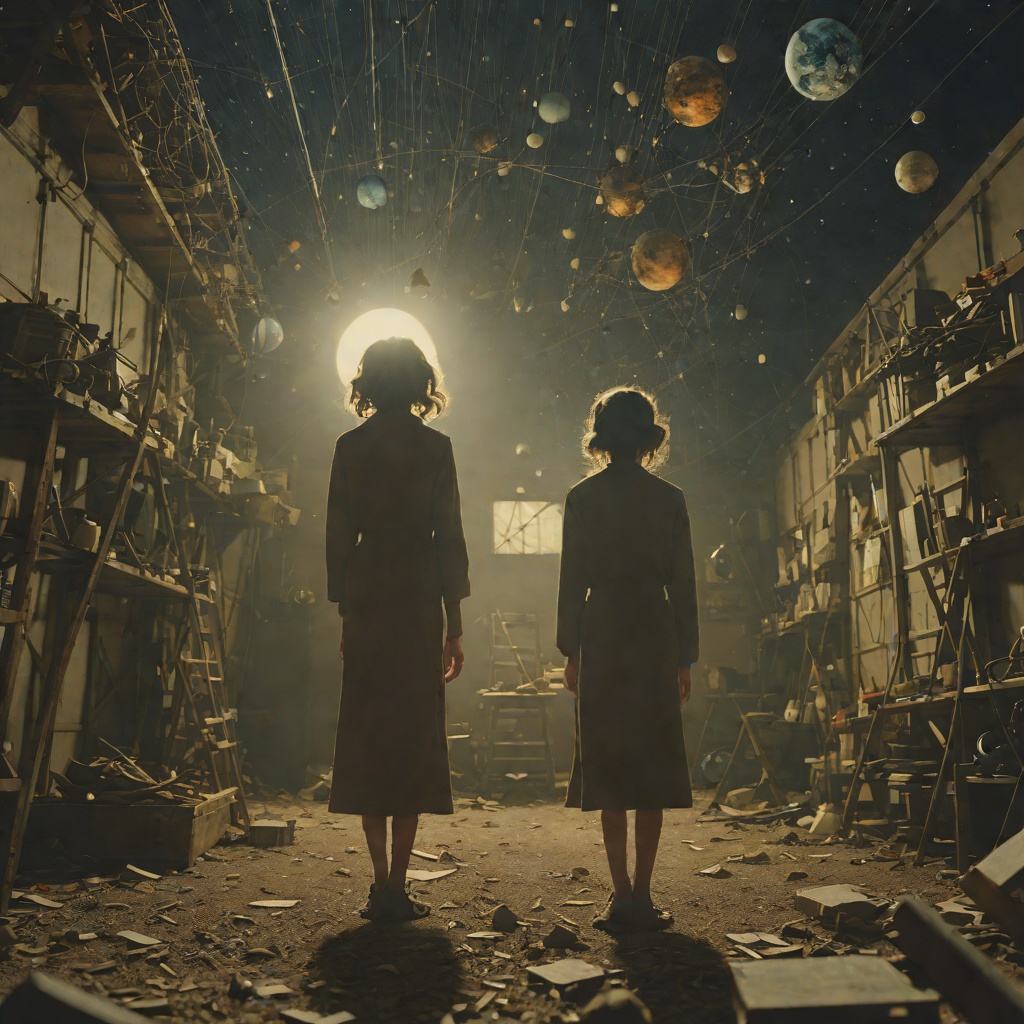
What followed defied her expectations. Mr. Emerson had no menagerie in his pockets. Instead, he talked in a familiar way about different kinds of spiders and their ways, and as he talked, he wove across the doorway where he stood a gigantic spider's web, unwinding a ball of twine and looping various lengths on invisible tacks he had ready in the door frame. Mary was fascinated by the progress of the web. She forgot her terrors and began to follow his discourse, surprised to hear how much there was to know about a dusty little spider besides that he could spin webs as fast as her broom could sweep them away. The drama of the spider's daily life became very real to her: his struggle for existence, his wars with his enemies, his wiles, his traps, his patient labors, the intricate safeguards of his simple existence, the fitness of his body for his surroundings, of his instincts for his vital needs. The whole picture of the spider's pursuit of life under the direction of definite laws filled her with great wonder and left no room in her mind for repugnance or fear. It was the first time the natural history of a living creature had been presented to her under circumstances where she could not avoid hearing and seeing, and she was surprised at her own dullness in the past when she had rejected books on natural history.
The Aftermath: A New Relationship with Nature
Mary did not become an enthusiastic amateur naturalist at once, nor did she immediately begin collecting worms and bugs. But the change was real and gradual. On the next sweeping-day, she stood on a chair, craning her neck to study the spider webs she discovered in the corners of the ceiling, and one or two webs of more than ordinary perfection she suffered to remain undisturbed for weeks, even though it was her duty as a house-cleaner to sweep the ceiling clean. She began to watch for the mice that were wont to scurry across the floor when the house slept and she alone waked, even placing a crust for them on the threshold of her room and cultivating a breathless intimacy with them when the little gray beasts acknowledged her hospitality by nibbling the crust in full sight. By degrees she came to a better understanding of her animal neighbors on all sides, and she began to look forward to the meetings of the Natural History Club. The club had frequent field excursions in addition to regular meetings—at the seashore, in the woods, in the fields, at high tide and low tide, in summer and winter, by sunlight and by moonlight—and the marvellous story of orderly nature was revealed to her in fragments that allured the imagination and made her beg for more. Some members were school-teachers accustomed to answering questions; all were patient, and some took special pains with her. Nobody took her seriously as a member, though; they called her the club mascot and appointed her curator of the club museum, which was not in existence, at a salary of ten cents a year, which was never paid. She was well pleased with her unique position, delighted with her new friends, and enraptured with her new study.
The Spider and the Larger Arc of Transformation
Mary herself framed the spider's significance in the largest terms. She compared her bookworm days, before she began the study of natural history outdoors, to the barren existence a lover looks back on with remorse and shame before meeting the beloved. The spider lecture at Hale House was, she declared, "the second transformation of my life, as truly as my coming to America was the first great transformation." This transformation echoed an earlier moment of natural revelation: on a spring day by the Polota River in Polotzk, watching a peasant plow a market garden and sing a rude plowman's song, she had felt "Life Universal" suddenly burst upon her, and for the space of a wild heartbeat she had her little hand on the Great Pulse. That first self-birth, she said, happened that spring day of her early springs. The spider's web at Hale House was a second such birth, a reconnection with the natural world that the cramped life of the slum and the bookworm's narrow pursuits had suppressed. The spider, the most loathsome creature she knew, became the instrument by which nature took first place in her affections, and the Natural History Club's excursions—including the day at Nahant spent studying marine life in tide pools, scrambling up and down cliffs for starfish, limpets, and sea-urchins, with a merry luncheon on the rocks and the tide rushing in to steal away their seaweed cushions—became the ongoing expression of that new life. The spider's web, woven across a doorway in a slum settlement house, proved to be a gateway not only to natural history but to the fuller American selfhood that Mary Antin was so deliberately constructing.